Java Developer Roadmap 2026: Your Complete Practical Guide
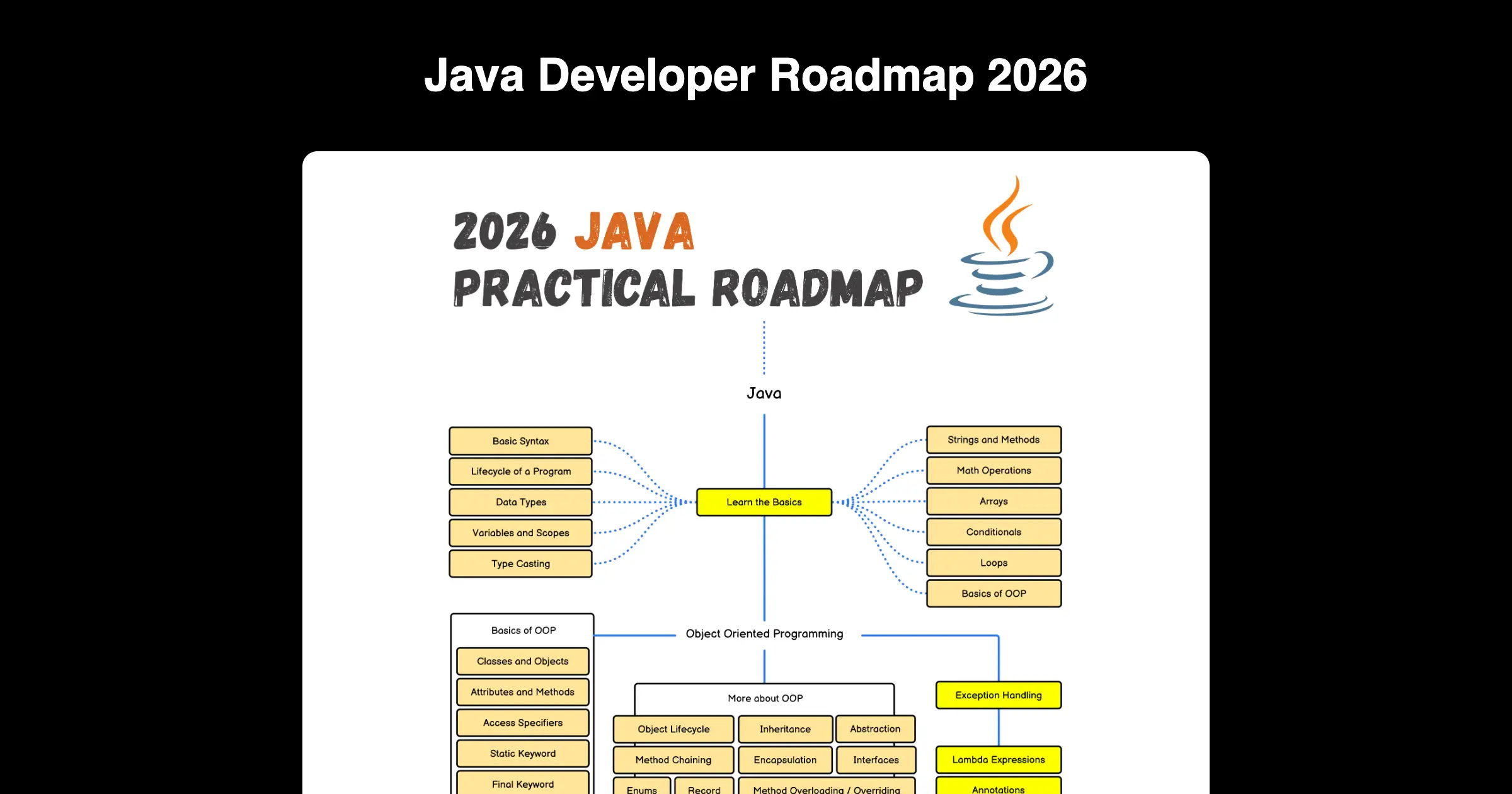
If you’re wondering whether Java is still worth learning in 2026, based on my personal experience as working in big tech company is a big yes.
Java remains one of the most trusted programming languages for backend systems, enterprise applications, and Android development. With modern updates like virtual threads and frameworks like Spring Boot, Java is faster, more efficient, and beginner-friendly.
So if you want to build powerful web apps or secure enterprise systems, learning Java in 2026 is a smart career investment and that is what the companies also demand from software engineers (check any job platform).
Java Roadmap 2026
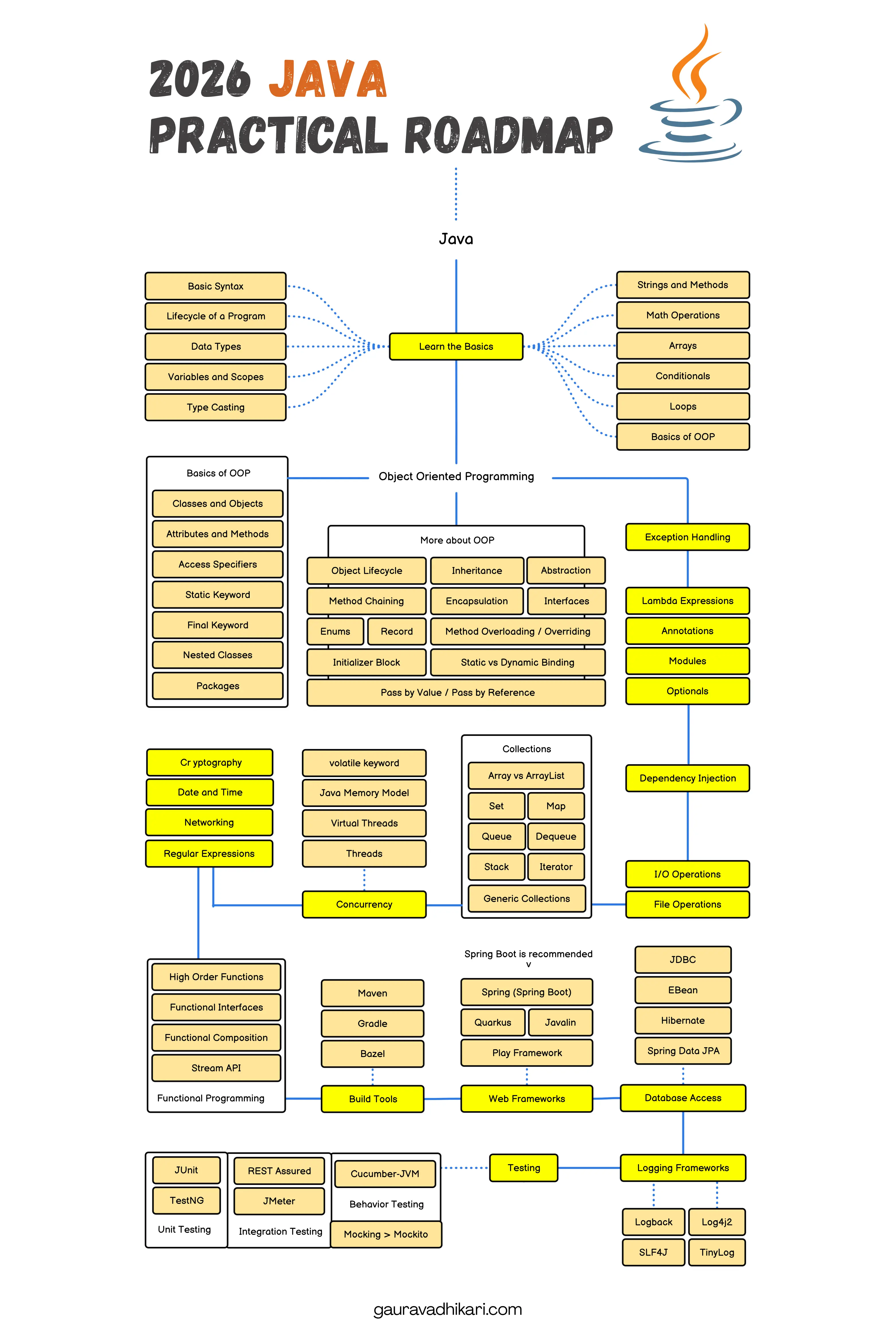
This roadmap is your step-by-step path from complete beginner to job-ready Java developer, covering everything from syntax and OOP to frameworks, databases, and testing.
Whether you’re just starting to learn programming or coming from another language like JavaScript, this guide will help you stay on track and not feel stressed. You can also check out 60 React Project Ideas for 2026 to practice your frontend skills alongside learning Java.
1. Learn the Basics
Everything in Java starts here. These fundamentals help you understand how code runs and interacts.
Focus on:
- Syntax, keywords, and structure of a Java program
- Data types, variables, and type casting
- Loops, conditionals, and arrays
- Strings and math operations
- Variables and scopes
Tip: Practice writing small programs daily. Build a calculator, a simple number guessing game, or a pattern printer.
2. Object-Oriented Programming (OOP)
OOP makes Java clean, organized, and reusable which is the core part of every Java project.
Focus on:
- Classes, objects, and constructors
- Inheritance, encapsulation, and polymorphism
- Method overloading and overriding
- Interfaces and abstraction
- Enums, static keyword, and nested classes
Tip: Think in real-world terms. For example, a Car class with Engine and Wheel objects helps you visualize OOP.
3. Collections Framework
Collections make it easy to store and manipulate groups of data efficiently.
Focus on:
- Lists, Sets, Maps, Queues, and Stacks
- ArrayList vs LinkedList
- Generics and Iterators
- Optionals and Exception Handling
Tip: Try solving small problems like counting word frequency or finding duplicates using a HashMap.
4. Functional Programming & Streams
Very Important. Modern Java embraces a functional style for cleaner, more readable code.
Focus on:
- Lambda expressions
- Functional interfaces
- Stream API and Optional
- Higher-order and composition functions
Tip: Try changing your old for-loops into Streams. It looks cleaner and works better once you get the hang of it.
5. Concurrency and Threads
Threads let your program do more than one thing at the same time, which makes it run faster (performance).
Focus on:
- Basics of Threads and Runnable
- Virtual Threads (Project Loom)
- Synchronization and volatile keyword
- Java Memory Model
Tip: Start simple. Make two threads that print numbers, then learn about thread pools and concurrent utilities.
Bonus: Once you start building real applications, learning how to containerize them is next skill to get. Check out our Docker Deep Dive: Beginner to Advanced to see how to build, ship, and run apps efficiently.
6. Build Tools (Maven | Gradle)
Build tools help you manage dependencies and automate builds.
Focus on:
- Maven basics: pom.xml, dependencies, plugins
- Gradle scripts for modern automation
- Running builds and managing versions
Tip: Begin with Maven because it’s simpler for beginners and widely used in enterprise projects.
7. Frameworks: Spring Boot
Frameworks help you build production-level apps faster and cleaner.
Focus on:
- Spring Core and Dependency Injection
- REST APIs with Spring Boot
- Profiles, Configuration, and Spring Security basics
Tip: Build a REST API that returns “Hello Java” in JSON.
8. Databases and ORM
Every application needs to store data somewhere.
Focus on:
- JDBC basics
- Hibernate and JPA for ORM
- Spring Data JPA for modern access
- SQL basics (MySQL, PostgreSQL)
Tip: Connect your Spring Boot app to a local database and perform CRUD (Create, Read, Update, Delete) operations.
9. Testing
Testing ensures your code is reliable and bug-free.
Focus on:
- JUnit for unit testing
- Mockito for mocking dependencies
- REST Assured for API testing
- Integration and load testing
Tip: Write at least one test for every important class. It will save you hours of debugging later.
10. Other Essentials
These extra tools make you a complete Java developer.
Focus on:
- Logging: Logback, Log4j2, SLF4J
- Networking and Regular Expressions
- File I/O and Stream handling
- Date & Time API and basic Cryptography
Tip: Explore gradually because these skills will naturally come as you build real projects.
Wrapping Up
Becoming a Java developer takes time, but it is worth it. You do not need to learn everything at once. Take one step at a time. Build small projects and keep getting better.
Java changes fast, but the basic ideas stay the same. When you know how to use objects and classes, frameworks, and databases, you can build a strong career.
Keep coding and stay curious. Remember, every Java pro once started with System.out.println("Hello, World!").
Frequently Asked Questions
Why learn Java in 2026?
Java continues to power enterprise systems, Android apps, and backend services. With updates like virtual threads and modern frameworks such as Spring Boot, it remains highly relevant for developers.
I’m a JavaScript developer — can I switch to Java easily?
Your existing knowledge of programming logic and OOP concepts will help you transition quickly. Start with Java syntax and OOP before exploring frameworks like Spring Boot.
How long does it take to become job-ready in Java?
With consistent effort, you can become job-ready in 5-6 months by following a roadmap, building small projects, and learning tools like Maven, Spring Boot, and JUnit.
Which framework should I start with?
Spring Boot is the best choice for beginners. It simplifies configuration, helps you build REST APIs quickly, and is widely used in the industry.
Do I need to learn all topics before applying for a job?
Focus first on Java basics, OOP, collections, and Spring Boot. You can learn testing, databases, and concurrency gradually while working on projects.
Do I need to learn databases?
Learning SQL and basic ORM with Hibernate or JPA is important for most real-world projects.
Can I get a job with just Java knowledge?
Yes, especially if you know Spring Boot, REST APIs, and have a few practical projects to showcase on GitHub.
Why choose Java over Python?
Python is great for quick scripts and AI, but Java is better for large, scalable applications. It offers strong typing, higher performance, and is preferred by many companies for backend and financial systems.
Can I learn Java and Python at the same time?
It’s possible, but not recommended for beginners. Focus on Java first to understand programming fundamentals deeply. Once confident, learning Python becomes much easier.
Can I learn Java in one month?
You can learn the basics — syntax, loops, and simple programs in a month. But mastering Java, including frameworks like Spring Boot, requires consistent practice over several months.
How can I learn Java step by step?
Follow a roadmap: start with syntax and OOP, move to collections and functional programming, then learn frameworks like Spring Boot and database access. Build small projects to practice along the way.
Which is harder to learn — Java or JavaScript?
They are very different. Java has stricter syntax and more structure, which is useful for large applications. Once you understand Java, learning JavaScript feels easier.
Where can I learn Java for free?
Start with free resources like Oracle’s official Java tutorials, W3Schools, or GeeksforGeeks. Combine these with coding practice on platforms like LeetCode or HackerRank.
Which should I learn first — Java or C++?
Start with Java. It’s simpler, has automatic memory management, and helps you grasp OOP concepts clearly. Once comfortable, learning C++ becomes easier.
How can I learn Java in an easy way?
Code daily, use visual roadmaps, build mini projects, and test your knowledge with small coding challenges. The more you practice, the faster Java will make sense.
WorkSage Hybrid Work Planner is a web based scheduling tool built for people working in hybrid mode (some days from home, some from office). It helps you plan and balance your “work from office (WFO)” and “work from home (WFH)” days according to what your workplace requires.
Try it now for free →